Given how irregular my entries on this site are so far, chewing over my old thesis again seems like a good way for me to blow the dust off my keyboard. After all, right at the end of the thesis I mentioned setting up this site as one of the “next steps” for what my research could lead to. I suppose I think of it like this: when you return to a conversation after a little time has passed, the first question you ask is “where was I?”.
Isn’t it old news?
I finished my thesis about two years ago, and if groups like the Graphic Medicine community are anything to go by, research in this area has enthusiastically continued. So, yes. My thesis is probably quite out of date in the sense of it being the latest research on applying sequential art to talking therapy, at least that would be my assumption. To get up to speed on where things are in the research literature I’d have to do another literature review. So why not do that instead of going over old ground? Partly it’s personal. I’m doing it to find myself in the subject again after a pretty long break. I want to get that sequential art hat back on again so I can look with a clearer perspective on where this subject is and what the future of it could be.
It’s also to do with unfinished business. Sequential art excels at making information accessible in ways that other mediums struggle to achieve. Academic writing is not necessarily about being accessible. Rigour, attention to detail, thoroughness, technical expertise, these are the things you’re aiming to demonstrate to a reader as a doctoral candidate so you can get the qualification you’ve been working hard for. If your work reads well on top of that, that’s a bonus.
By going back to my thesis I’m hoping I’ll get some of that personal reorientation, an energising visit to the past to inspire me towards the next step or two. I’m also hoping that I’ll find a way to say things about my research that are interesting, and are written as part of a conversation with whoever reads what I write, rather than a demonstration of how “doctoral” I can be. Chats are more fun than exams.
So is it old news? Yes, more than likely. Is it a waste of time? No, not for me.
Can’t you just do a quick summary?
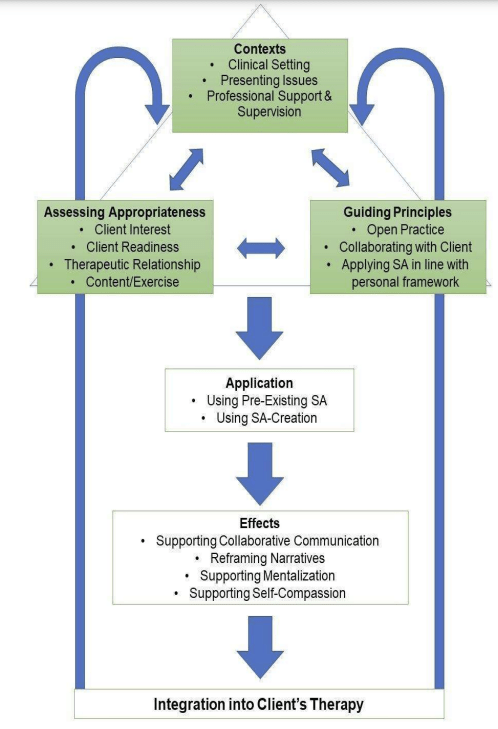
I suppose I could, yes. I could try to squish my conclusion and discussion down to a few paragraphs, stick my final diagram on it like a sticker, and call it a day. I don’t really want to though. Academic writing involves a lot of editing and cutting. At one stage I had a whole section on how sequential art has been used as an education tool in psychology, which was months of work, but I had to cut it. A little of the spirit of that section survived into the final draft, but there was a lot of stuff on the cutting room floor by the time everything was done. And like I indicated earlier, I like a chat. There were lots of questions raised by my research that I’d like to keep exploring, which I think I can do here.
Didn’t you only focus on one question? How much is there left to say?
Officially, yes. You do have to find a single question to pursue when you’re doing this sort of research so you can keep focused. Losing focus is deadly with long-form research. I remember that one of my cohort changed their research subject seven times (maybe more?) while we were training together, which caused them a lot of stress and uncertainty. I always felt very fortunate to have discovered a subject that felt as meaningful to me as this one did, and still does.
Even having said that, there’s a surprising range of directions you could take when looking into sequential art in relation to mental health. And on top of that, although I focused on one question, I only arrived at the beginning of the answer. How can sequential art be applied to talking therapy? Lots of ways. Will people come up with new ways that I didn’t explore? No doubt.
After years, and hundreds of pages, I only scratched the surface. Sequential art is a whole medium, a whole technology. The potential for application is vast, so no, we certainly haven’t run out of things to say or to explore.
What’s the point of all this anyway?
As I said, I get something personal out of revisiting this research, and with any luck someone else might get something out of it as well. Ultimately, it’s fun. That’s enough of a reason to explore something, what more point do you need than that?
 Sequential Therapy
Leave a comment