If you’re interested in comics in relation to psychology or mental health, you’ve probably heard the term Graphic Medicine. To me, this term refers to a community that I consider myself a part of. I’m not as active as I’d like to be, but there are a few groups I’m in that I could say the same about.
As a matter of fact, I owe a debt of gratitude to the Graphic Medicine community in relation to my thesis because they allowed me to use their website to put out a call for participants. That post was a big help with recruiting, which had a real challenge up to that point.
This week is the fifteenth annual Graphic Medicine conference. The conference tends to move around, and the last time it was near me was back in 2019 when it came to Brighton. That’s about an hour away by train from London, where I live. Since then, all the conferences have been in North America, and that’s a pricey plane ticket for a self-employed psychologist.
So, when I discovered this year’s conference would be in Athlone, in central Ireland, I was dead set on going. I thought I might make a trip of it: attend the conference, visit some family, and maybe squeeze in a day or two in Galway. Unfortunately, life has been far too busy recently to allow for the trip, so I’ll miss the conference again this year.
While that’s a disappointment, it has given me a chance to look back at the 2019 conference, where I co-hosted a presentation on the application of sequential art to talking therapy with my transatlantic colleague, Devlyn McCreight. At the time of the conference I was still in the process of working through the analysis of my interview data, so didn’t have my results together in full. Although this analysis was something I was still finishing, I did have some initial impressions of what my data was saying at this stage.
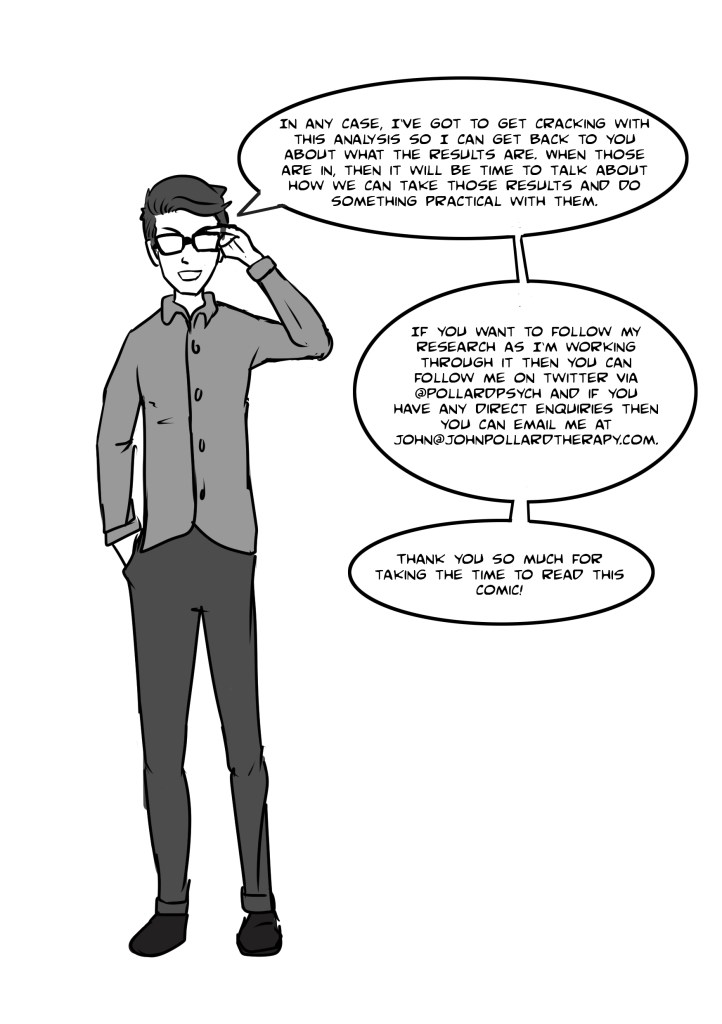
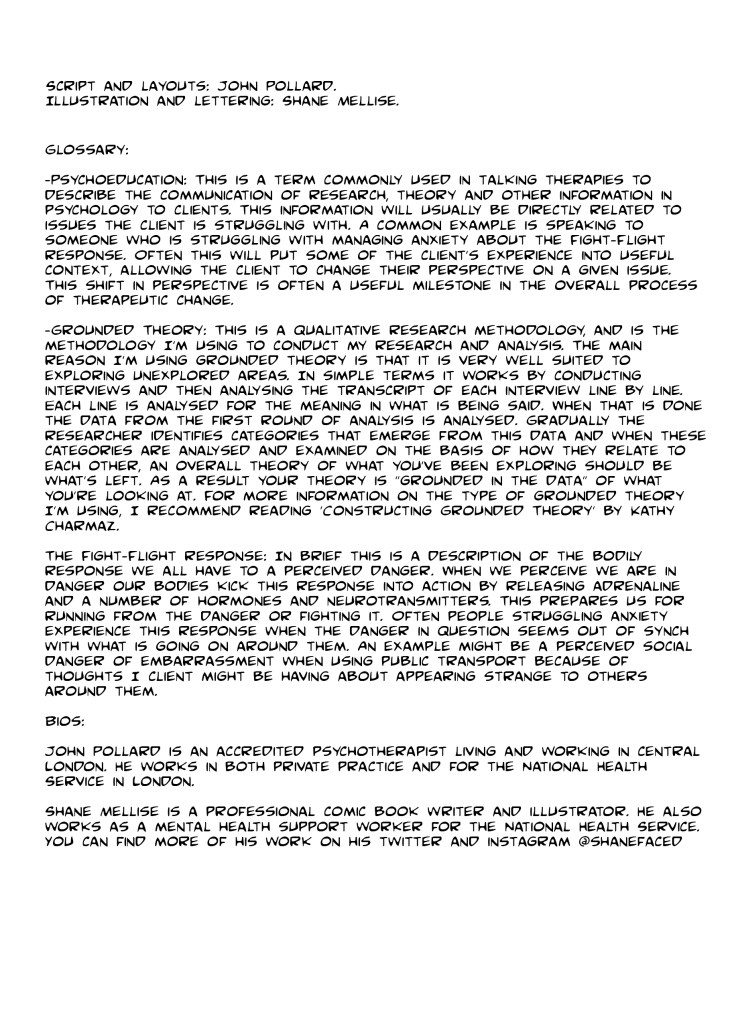
I wanted to get people engaged with the project, so to promote it I made a comic about how the research was progressing with my friend and colleague Shane Melisse. We provided one hundred copies at the conference as a free giveaway, all of which were snapped up.
Here’s the comic for you to check out:


Psychotherapist? I thought you were a psychologist.
I’m both. I first qualified as a psychotherapist and then earned my qualification as a psychologist by completing my thesis research. I’ve been working in mental health for around sixteen or seventeen years, and these two qualifications are the latest stages of my progress in this field.
Are you really saying reading comics got you into university?
I’m saying that reading comics set me up for being more confident in reading generally, and that boosted my overall academic confidence. Reading comics when I was a kid was an early building block towards cultivating the confidence and interest in engaging with school that eventually led me to university. So it wasn’t a direct ‘read comics, enter university’ pipeline, but I have significant doubts that without that early experience I would have believed getting into a university was a possibility for me.
Why did you include this personal stuff anyway?
In the thesis this was a requirement. My official readers (my assessors) expected a representation of my personal connection to my research topic. This can make for more interesting reading for them, but there are also some more technical reasons for this.
In psychology and psychotherapy it’s important to be able to demonstrate “reflexivity and self-awareness”, especially when you’re doing qualitative research. This allows you to acknowledge and speak to any biases you may have that readers can take into consideration when evaluating your work. It makes your work more transparent and trustworthy to people consuming your writing, which ultimately makes for a better quality piece of research.
Although readers of the comic wouldn’t have needed any of that, I still felt as though it would be more engaging to include it so readers would know some of the personal context to the project.
It sounds like you found this subject by accident?
In a way, yes. The encouragement I received after my presentation helped me consider researching this subject seriously. The presentation idea came about serendipitously under pressure to meet a deadline (the presentation was assessed).
Coming up with something personally resonant had been strongly recommended. At the same time I had come across a discussion online featuring a psychologist called Patrick O’Connor, who used comics in his clinical work.
That linked up with something I had a history with, I looked into it some more, and found there was a really interesting subject there. That was about twelve years ago, and I’m still engaged. I think that’s a pretty lucky break.
Are you sure making a comic instead of a powerpoint presentation was a good idea?
Fair question. I did make a lot of work for myself with this decision and powerpoint probably would have done the job. You might start to notice a pattern here, but in the preparation for my psychotherapy viva, I was strongly encouraged to make it personal in some way.
The panel generally wants to get to know the person they’re potentially about to qualify as a practicing therapist, partly so they can feel confident they’re a safe and responsible practitioner that cares about their work.
Once the idea of using the comic as my method of presentation crossed my mind, I couldn’t ignore it. Anything else seemed less personal, less engaging, and less interesting.
Would I do it again? Maybe, depending on the circumstances. Making a comic is time-consuming, but it can be very effective for making a point clearly and emphatically.
How do the initial findings compare to the final results you had when the project was completed?
The final results are more complex, for one. I will talk about them here in more depth in future.
One big difference is that I didn’t pursue the subject of applying sequential art to psychology and psychotherapy outside of clinical practice in the final project.
I actually spent quite a lot of time developing this topic, but leaving it out made the thesis more coherent. That wasn’t an easy decision because I think using sequential art as a medium for engaging with the public as a psychologist is very important. For clarity’s sake though, focusing solely on clinical application made sense.
 Sequential Therapy
Leave a comment